
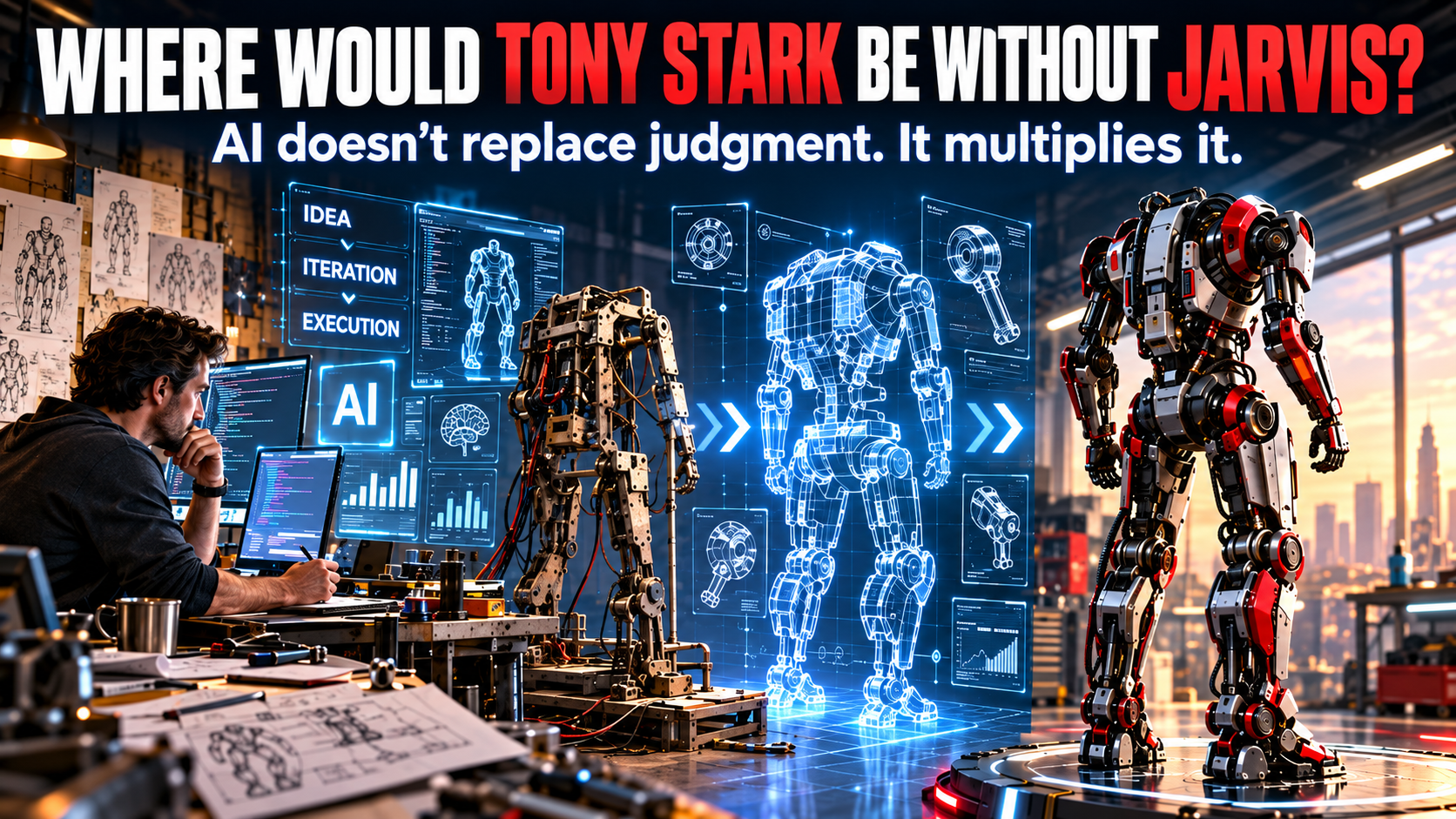
Tony Stark built the first Iron Man suit in a cave. It was crude and sort of ugly. It barely worked. But it worked. (And it was still cool.) Importantly, he built it without JARVIS. That matters, because it explains something about AI that both the evangelists and the skeptics keep getting wrong: AI is not going to magically turn everyone into Tony Stark. And Tony Stark does not suddenly stop being Tony Stark if you take JARVIS away. But give Tony Stark JARVIS and something important happens: The distance between idea and execution collapses. This is what I have noticed most since I started seriously using AI.
My problem has never been a shortage of ideas. If anything, it's the opposite. My mind has a bad habit of producing ideas faster than I can do anything with them. I build software, games, websites, data systems, random tools, "in real life" projects, things nobody asked for, and things that occasionally should have remained ideas. Before AI, every one of those ideas competed for the same limited resource: Me. I can write the code. I can do the research. I can work through the math. I can troubleshoot the problems. I can learn whatever additional piece I needed to learn. But all of that takes time. AI changed the equation.
I have built games that I absolutely could have coded entirely myself. I have finished procedural world-generation software for which I hand-wrote much of the underlying code and logic. I have projects where I understand exactly what the software should do, how it should behave, and why. Now I can describe a change, have AI produce an implementation, look at it and say: Nope. Or, that part is wrong. Or, that mechanic violates the design. Or, that list is not even alphabetized. Or, that UI hierarchy is backwards. Or, that code solves the wrong problem. And then we fix it. The next version might expose another problem. So I fix it. A few iterations later I have something which might have taken me days or weeks to hand-code from scratch. The AI did not replace my ability to code. It gave my ability to code more bandwidth.
The same thing happens outside software ("in real life"). I am planning a deck on some rural land. I can work through the structural questions myself. I can research lumber spans, loads, weather conditions, slope, drainage, hardware and construction techniques. (And I have already done a lot of this.) But doing all of that manually means finding information, comparing sources, calculating stresses, checking assumptions and repeatedly revisiting the design. AI can help me process those practical considerations much faster. It does not necessarily know something I am incapable of understanding. It just gets me to the next useful question faster. That is JARVIS.
There is a scene in Iron Man (2008) where Stark looks at one of his cars and tells JARVIS "Throw a little hot rod red in there." That sounds trivial. It isn't. Without JARVIS, that intent has to move through a much longer chain of design, testing, materials, and manufacturing decisions. With JARVIS, Stark expresses intent and the system helps turn that intent into execution.
A lot of the early criticism of generative AI missed what was coming. Sure, much of the early AI-generated art was terrible. A fair amount of it still is. But that does not prove AI cannot produce good work. It proves that AI can scale bad judgment just as effectively as it can scale good judgment. As the tools have improved, I have watched increasingly impressive AI-based short films, artwork and creative projects appear from people who previously would never have had the money, staff, equipment or time required to make them. AI did not give those people taste. It did not give them imagination. It did not give them storytelling ability. It removed obstacles between those abilities and the finished product.
The same applies to programming. Someone who does not understand software can use AI to generate a lot of code very quickly. But that doesn't mean the code will be good. If you do not understand architecture, logic, maintainability, edge cases or user experience, you may not even recognize when the AI has produced something fundamentally wrong. And one of the most important skills in working with AI may be knowing when its answer is wrong.
That brings me to data and analytics (because there's always data and analytics). There is a growing belief that natural-language analytics will somehow make everyone an expert data analyst. Ask the AI “Why were sales down last month?”, and it will analyze the data and tell you. Great. Except: What exactly does “sales” mean in that system? Which customers are included? Which transactions are missing? Did somebody misuse a field? Did the underlying business process change? Are two systems defining the same customer differently? Is the apparent trend real, or is it an artifact of the way the data was collected? And what other data can we incorporate in to the system to give us better answers?
What question is the executive actually trying to answer? An AI analytics interface can make it easier to ask questions of data. It cannot make a bad question good. Natural-language analytics removes the syntax barrier. It does not remove the understanding barrier. This is why I do not believe AI eliminates the need for experienced analysts, data architects or people who deeply understand both the business and the underlying data. I think it makes those people more valuable.
A strong analyst with AI can investigate faster, test more possibilities, build more quickly and spend less time on mechanical work. A weak analyst with AI can produce a beautifully formatted wrong answer at extraordinary speed. Giving someone an AI analytics interface does not automatically make them a data analyst any more than giving someone JARVIS makes them Tony Stark.
Tony Stark without JARVIS is still Tony Stark. JARVIS without Tony Stark does not invent Iron Man. Put them together, though, and the iteration cycle becomes absurdly fast. That is the part of AI I think matters most.
AI does not have to replace your judgment to radically increase the value of your judgment. It can give expertise more reach. It can give creativity more throughput. It can turn days of mechanical work into hours of iteration. And when the person directing it actually knows what he or she is doing, the result can be something neither human nor machine would have produced nearly as effectively alone.
The future is probably not humans versus AI. It is people who know what they are doing using AI to do far more of it. Tony Stark built the first suit in a cave. JARVIS helped him build the rest.