
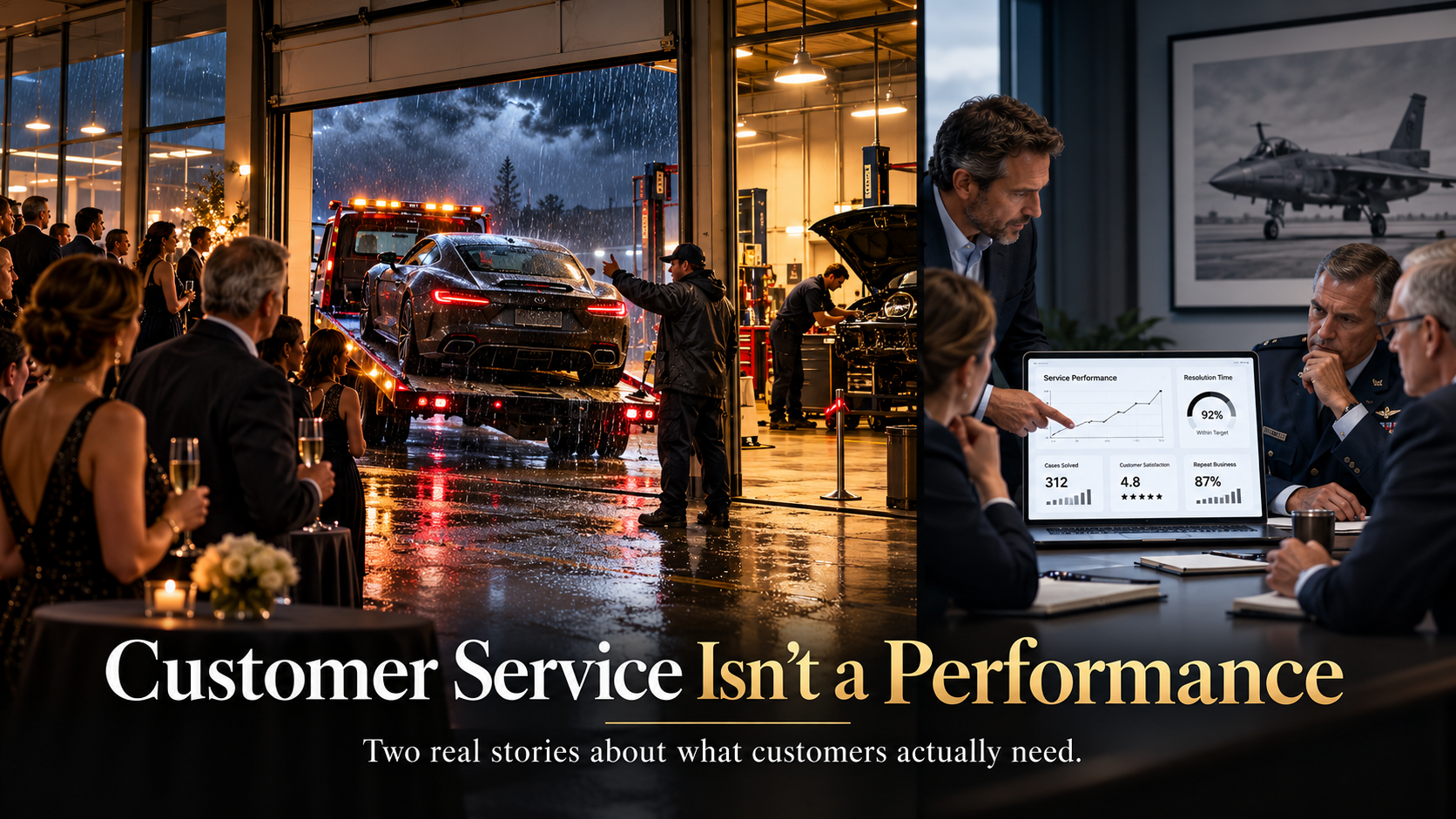
I've got two true stories from the front lines of customer service. (I have plenty of stories, but these two are particularly good examples - ask me about trading cigarettes for a luggage cart in the USSR.) Not the kind they teach in corporate training sessions, where everyone smiles, follows a script, and congratulates themselves on putting the customer first. These are stories about what happens when real customers need something and the companies responsible for helping them have other priorities.
The first involves a broken high-end sports car, a violent rainstorm, and a dealership owner who was considerably more interested in his party than his customer. The second involves a major defense contractor, a multimillion-dollar analytics engagement, and a fighter plane from the 1960s.
They're very different stories, but they illustrate the same problem.
A Tow Truck Crashes the Party
In the mid-2000s, I was managing the service department at a high-line auto dealership. We were preparing for a large evening event celebrating the introduction of a new sports car model. The dealership owner wanted everything perfect, including a spotless service department.
Unfortunately, nobody had bothered to tell me or the technicians until the day of the party. Several were in the middle of major repairs, and suddenly we were expected to clear the entire workshop.
One technician had a car on a lift with its engine sitting on the floor beneath it. There was no reasonable way to move either, so I suggested we clean the area, rope it off, and leave the engine on display. Most owners had never seen their engine outside the car, and I suspected they'd find it fascinating.
The dealership owner was furious. But there wasn't much else we could do.
A few technicians, including the shop foreman and the technician working on the engine, agreed to stay for the party and answer questions. (This was out of the ordinary, but I told them they could relax and have a glass of wine.) When the guests arrived, they began wandering into the shop, gathering around the exposed engine and chatting with the technicians.
It was an enormous hit. Customers were getting to know the people who actually worked on their cars, in a relaxed setting where nobody was upset about a repair bill. The technicians actually enjoyed it, too.
Then it started raining. Not ordinary rain, but wind-driven, nearly sideways rain that eventually developed into a full-blown storm.
In the middle of the party, a tow truck driver approached me. He had a disabled car and wanted to know where to unload it.
Before I could answer, the dealership owner appeared, berated the driver, and ordered him to leave the car in the supermarket parking lot next door, out of sight of the party guests. He practically spat out the words "tow truck."
I suggested bringing it into our workshop, which was already open.
Absolutely not.
By then, the owner of the broken car had arrived and heard the exchange. He looked defeated and headed back out into the storm.
Our dealership was hosting an elaborate party to celebrate how wonderful our cars were, while an actual owner with an actual problem was being sent into the rain so he wouldn't spoil the scenery.
I wasn't having any of that.
I grabbed my rain jacket and an umbrella, asked our receptionist to prepare a glass of wine, and went outside. I found the customer standing in the torrential rain beside the tow truck, handed him my umbrella, and told him we'd take care of him. I then instructed the driver to bring the car into our service department.
The driver hesitated. The owner had told him otherwise.
I told him we were doing things the right way.
Inside, our receptionist greeted the customer warmly and put the glass of wine in his hand. I explained that we were hosting a new model launch party, but his car was my priority.
As the tow truck began backing into the workshop, the dealership owner looked ready to explode. I stepped forward and announced to the assembled guests that they were about to witness an active service engagement, and asked them to keep the area clear.
They were delighted.
The technicians helped guide the truck, the guests watched with interest, and I brought the customer into my office to discuss his car. His engine had died suddenly, and from the symptoms I suspected a catastrophic failure involving a defect that was becoming notorious among technicians.
Eventually, his wife arrived, and he left reassured that we'd investigate and contact him shortly.
The tow truck driver thanked me for letting him unload inside, particularly given how severe the storm had become.
Then the dealership owner approached me, looking ready to tear my head off.
Before he could say anything, one of the guests interrupted to tell him how impressive it had been to watch the service department take care of a customer during the celebration. Several others joined in.
The owner's expression changed immediately. Suddenly he was enthusiastically explaining how important customer service was to him and how this was exactly the sort of experience the dealership wanted to provide.
One of the customers caught my eye and winked.
The next few days were less entertaining.
We confirmed the engine had suffered a catastrophic failure involving a defect the manufacturer had been reluctant to acknowledge publicly. The car was only slightly outside its warranty, but a replacement engine was going to cost tens of thousands of dollars.
I contacted the manufacturer directly, explained the situation, and negotiated substantial assistance toward the repair. I then worked with our dealership group's general manager to cover the remainder rather than charge the customer.
The decision modestly affected my personal bottom line, but I wasn't particularly concerned. The customer had purchased the car new from our dealership, had experienced a dangerous engine failure, and had already been treated poorly during the storm. I wasn't about to hand him a bill for thousands of dollars on top of everything else.
We replaced the engine and presented him with a zero-dollar invoice.
He was ecstatic.
Three Gauges. No Baloney.
Years later, I was working for a software platform company as a data and analytics consultant when I was assigned to a major engagement with a large defense contractor.
Things were going badly.
The defense contractor was trying to understand customer relationships and sales cycles that could stretch across decades. The platform kept presenting colorful dashboards, elaborate transitions, and generic customer management demonstrations that showed off its capabilities without solving the customer's problem.
The contractor had already removed two of the platform's project leads. The customer was furious and threatening to abandon the multimillion-dollar engagement, along with all potential future business.
My manager finally asked whether I had any ideas.
I did.
I'd been listening to the customer team describe its challenges, and I thought two measurements could help: Customer Strength and Customer Health. One would describe the depth and commercial strength of a relationship; the other would evaluate how well that relationship was performing. Both could be adapted to unusually long sales cycles.
Without getting my full explanation, my manager told me to build something. There was one minor complication: I didn't have the data required to do it.
At the next customer meeting, I replaced the standard platform video-call background with a photograph of a particular 1960s-era fighter plane, which happened to have been manufactured by our customer. But it's legitimately my favorite airplane of all time. Someone on our platform team made a sarcastic remark about trying to impress the customer.
I explained that I'd always admired that aircraft for its remarkable engineering and the courage of the people who flew it. (And we're talking an insane amount of courage.)
The customer team lead then saw my background image and said, "Hey, I flew those."
I was stunned. Of all the aircraft I could have chosen, I'd picked one that the man sitting across from me (on a screen) had actually flown.
We ended up having a terrific conversation about the aircraft, its history, and his experiences. When we returned to business, I explained the analytical approach I was considering and asked whether his team could provide some data.
He agreed.
The information I received was insufficient for a proper demonstration, so I built my own synthetic dataset. I gathered publicly available product information and wrote some custom code to generate decades of realistic customer interactions, opportunities, meetings, communications, and financial activity.
Then I developed the metrics and built the dashboard.
It was deliberately simple. A few gauges, a handful of KPIs, standard filters, and a table showing the underlying information. Black text on a white background. No flashy colors, animations, transitions, or other visual nonsense. It was compact enough to fit comfortably on a laptop screen.
The complexity was in the calculations and relationships behind the interface, not in the interface itself.
My boss hated it.
At an internal review prior to the reveal, several managers openly ridiculed the dashboard, arguing that its simplicity made the platform look primitive and technically unimpressive.
Then they admitted they had nothing better to show the customer.
So we showed it.
When we presented it the next day, the customer's reaction was immediate
"This is great."
He began asking questions about the metrics, calculations, and underlying data. The platform team lead couldn't answer them and eventually acknowledged that I'd built it.
I explained the synthetic dataset, the logic behind Customer Strength and Customer Health, and how the approach could be extended to the customer's actual relationships.
The defense contractor team loved it. They appreciated the simplicity, the transparency, and the fact that the system addressed the problem they'd been describing for weeks.
The lead representative finally said, "Well, now we have something to work with."
The engagement was back on track.
Over the next two weeks, I worked directly with the customer team, explaining the calculations, sharing the underlying code, and helping them understand how to develop the approach further. Interest quickly spread to other departments.
Platform management remained considerably less enthusiastic. My solution didn't fit their preferred vision of impressive colors and flashy graphics, despite the customer's response. Shortly afterward, they removed me from the engagement.
Apparently, solving the customer's problem wasn't quite the same thing as demonstrating the product the way management wanted.
The Difference
In one case, a dealership tried to hide a broken car because it might spoil the party. In the other, a software company repeatedly demonstrated its impressive technology without addressing the customer's problem.
Both customers ended up appreciating something their respective vendors hadn't wanted them to see.
There's nothing wrong with a great presentation, a beautiful product, or an impressive demonstration. But none of those things means much if you're not delivering what the customer actually needs.
Customer service isn't a performance. It's understanding the customer and taking responsibility for the outcome.
Sometimes that means bringing a tow truck through the front door during a party. Sometimes it means building a dashboard that nobody in your own company likes.
And sometimes it means doing the right thing even when the people signing your paycheck would rather you didn't.