
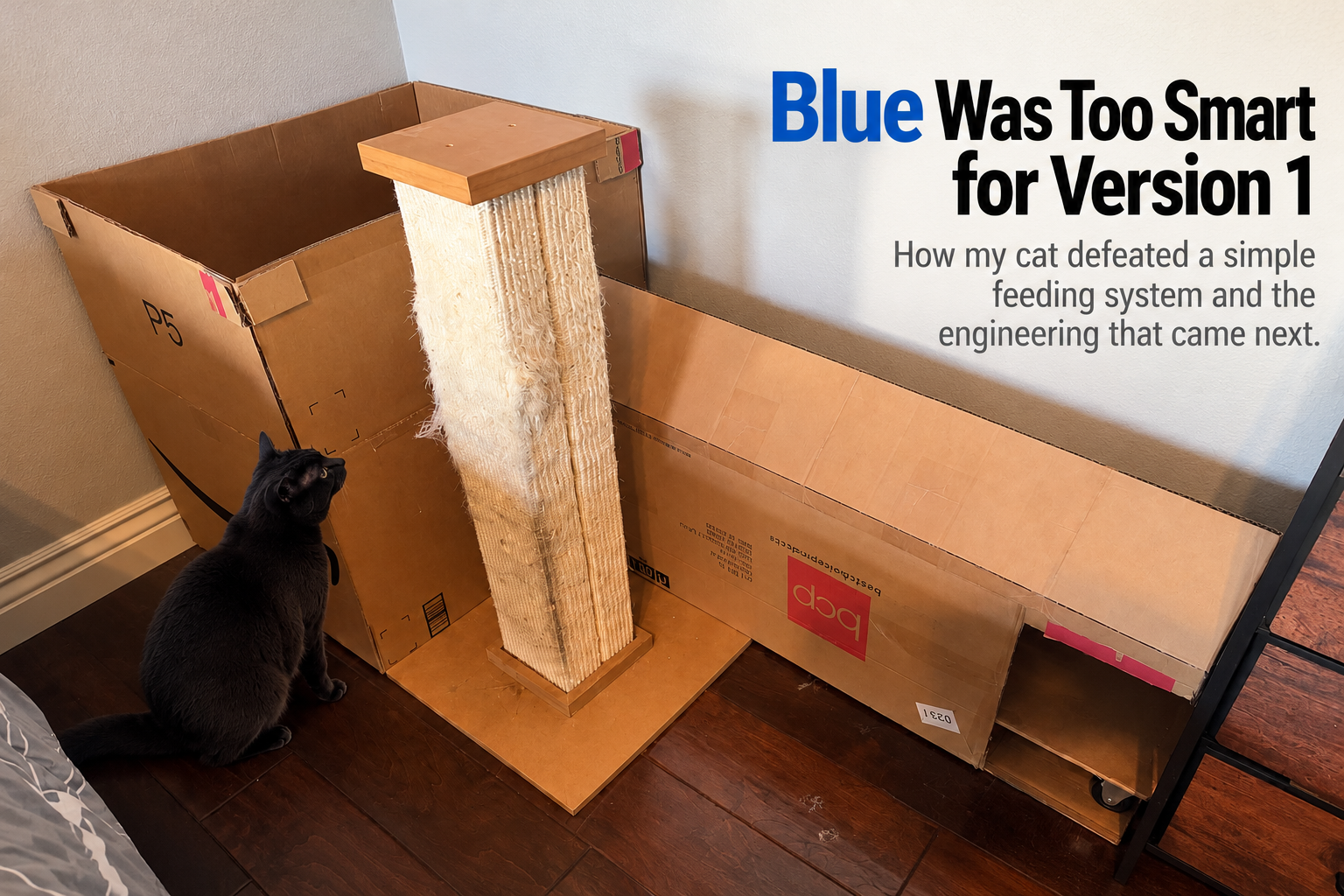
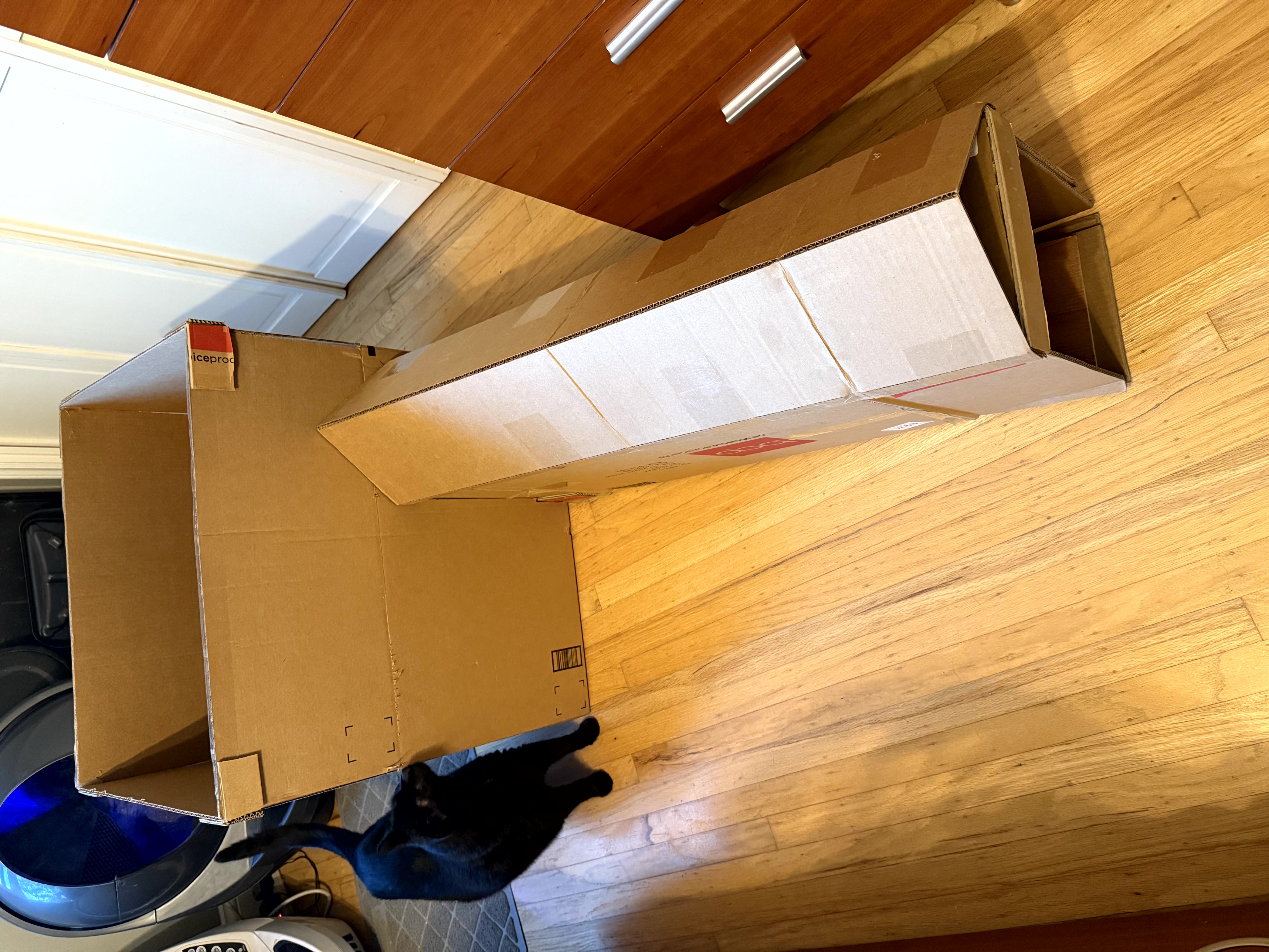
I have three cats. And when it comes to food, two of them are perfectly normal. They eat when they're hungry, stop when they're full, and generally behave like reasonable creatures. The third is Blue.
Blue is a large, entirely black cat named after the velociraptor in Jurassic World. My son named him when he was a kitten (when Blue was a kitten, not when my son was a kitten). In his prime, Blue was a magnificent, lean, athletic 14-pound animal. He was also (and still is) exceptionally gentle and surprisingly intelligent.
Then something happened. That thing was a dog.
During the chaos and insanity of 2020 and the years that followed, our family (wife) decided we needed another dog. A big dog; a protective dog. And because her best friend had one, a German Shepherd Dog. Enter Elke, possibly the sweetest, most gentle German Shepherd that was ever a dog. However, Blue seemed to think differently. We suspect that out of anxiety over the new dog, Blue decided that eating was no longer something he did to stay alive. It was now his purpose in life.
In almost no time, Blue ballooned to something more akin to an oversized medicine ball. ('Oversized' is actually a sizing label for these things. Who knew?) And it rapidly became a real problem. Blue was having trouble jumping onto furniture, was exhibiting behavioral problems, and was generally miserable. A trip to the veterinarian confirmed what was obvious: Blue needed to lose a substantial amount of weight as soon as possible.
So I put him on a diet. Ridiculously expensive prescription food, carefully measured portions, regular weigh-ins. He even spent some time living in a spare upstairs bathroom, complete with his own bed, litter box, and scratching post. And it worked. Eventually Blue lost enough weight that I could let him roam the house again.
There was just one problem. The other two cats, Princess Beef and Echo, had always eaten from a gravity feeder. It was simple, reliable, and required practically no attention. Fill the thing periodically and the cats take care of themselves. Except Blue couldn't be trusted around it.
I could have switched all three cats to individual scheduled feedings, but I had no interest in turning feeding the cats into a part-time job. There were also electronic feeders that could identify individual cats, but they were expensive, and I would have needed multiple units. I wanted something simpler.
I wanted something mechanical. Something that required no electricity, no batteries, no software, and no ongoing intervention. And one day, in the shower (because for some reason a lot of my good ideas come to me there), I figured it out.
The Invention
The solution was a lever. Actually, two levers, but stuck together. The idea was simple: two hinged pieces of wood, placed inside a tunnel, arranged so that an average-weight cat could walk through without triggering the mechanism. A sufficiently heavy cat would depress the ramp, causing the panel ahead to pop up and block the passage.
Princess Beef and Echo would have access to their food. Blue would not.
I already had some scrap plywood, a few hinges, and a couple of large cardboard boxes. Using far too much hot glue and our dining room table as a workspace, I turned one box into a feeding enclosure and the other into a tunnel. But Blue is a clever cat (I had yet to find out how clever), and I knew he'd just jump onto the tunnel and then into the open feeding box. Solution: the tunnel needed an angled roof. So I put one on top, which also helped strengthen the pretty flimsy construction. I thought that was pretty clever.
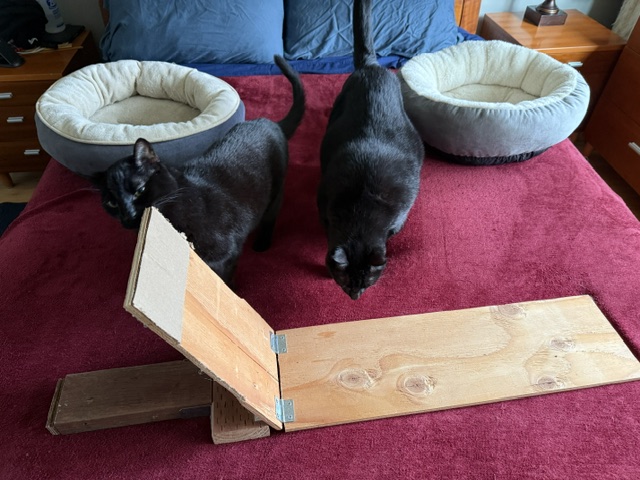
In the garage, I cut the plywood, attached the hinges (with screws I filed down so the protruding points wouldn't harm the kitty feet), assembled the lever mechanism, and tested it. It worked! But I needed to test it with an actual cat. I selected Echo, who weighed approximately 10.5 pounds.
Echo was not enthusiastic about being placed on a wooden contraption sitting on sawhorses in the driveway. She became considerably less enthusiastic when the panel suddenly popped up. In approximately one second, Echo appeared to develop fifteen legs and twenty-seven claws. By the time I got her safely back inside, I was bleeding. Apparently, some adjustments were necessary.
The Ammunition Phase
The mechanism needed a counterweight.
As luck would have it, my best friend had a supply of 115-grain 9mm lead bullets. Not cartridges or loaded ammunition. Just the lead projectiles. Why did he have them? Let's not go there. He gave me a box. After considerable experimentation, I hot-glued twenty bullets to the underside of the rising panel. (Yes, hot glue again. You'll be hearing more about that.) The result was a mechanism balanced so that the smaller cats could pass through while Blue's weight would trigger the barrier.
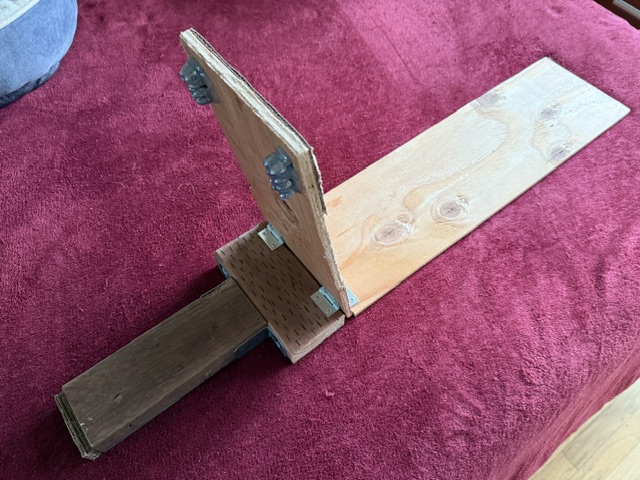
I installed everything in the tunnel, attached the tunnel to the feeding box, and introduced the cats. Princess went through, ate some food, and came back out. Echo went through, ate some food, and came back out. Blue approached, smelled the food, and confidently entered the tunnel.
BANG! The panel shot up. Blue reversed out of that tunnel like a race car that had suddenly discovered reverse gear.
Success! I was a genius. For a while.
Blue Discovers A Vulnerability
One night, lying in bed, I heard a cat eating in the feeding box. Princess was sitting on the dresser. Echo was curled up beside me. Which meant... "BLUE!"
The cat food contraption went BANG, and Blue launched himself out of the tunnel and disappeared down the hallway. What the hell? The next day I discovered the problem. The rising panel was rubbing against the cardboard tunnel walls, creating enough resistance to delay its operation. But this meant Blue was testing the machine. He was testing me.
Easy fix. I removed about a quarter-inch of material from the sides of the panel. Problem solved. Until I caught Blue eating again.
This time I installed a Wyze security camera inside the feeding enclosure, mounted to a 2×4 with a couple of clamps. I configured motion notifications so I could see exactly who was eating. This proved educational. Apparently, cats visit their food bowls a LOT.
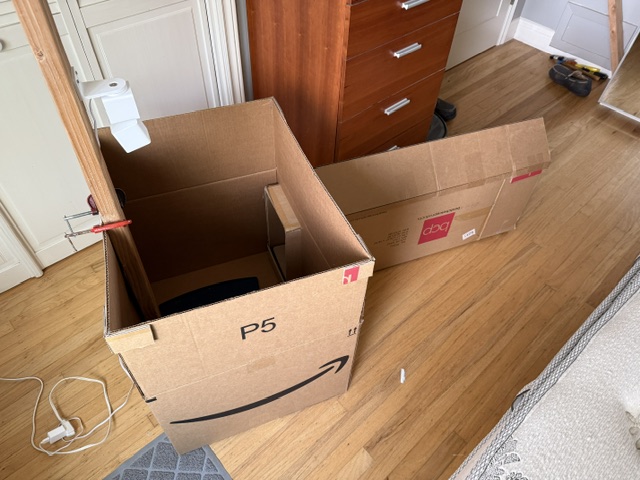
Then, while traveling across the country on business, I received another notification. I opened the camera feed from 33,000 feet. There was a black cat eating. But something wasn't right. It was an awfully large black cat. BLUE!
I activated the camera's microphone and told him to get out of the box. He looked up, gave me what I can only describe as the feline equivalent of a "haha, screw you" smirk, and went right back to eating. I had been defeated by a cat - remotely.
Blue Forces A Redesign
Through observation and experimentation, I eventually figured out what Blue was doing. He had actually learned where to place his paws to avoid triggering the mechanism. The original lever had only about 1.5 inches of overhang, which meant the mechanism needed a fairly specific amount of force applied in just the right place. Blue had found a loophole: where not to step.
I disassembled the entire mechanism, raised its base by another 1.5 inches, and repositioned the hinged 'pop-up' panel to create three inches of overhang. Now the mechanism required substantially less force to activate. Unfortunately, the original twenty bullets were nowhere near enough counterweight.
Initially I tried more bullets, but some basic calculations told me I didn't have enough of those. Not having anything else on hand, I tried smaller weight plates. The I tried moving them around - a lot. I spent roughly an hour standing in my driveway in the hot sun, sliding barbell plates along the wood, making marks, measuring, testing, and generally questioning my life choices.
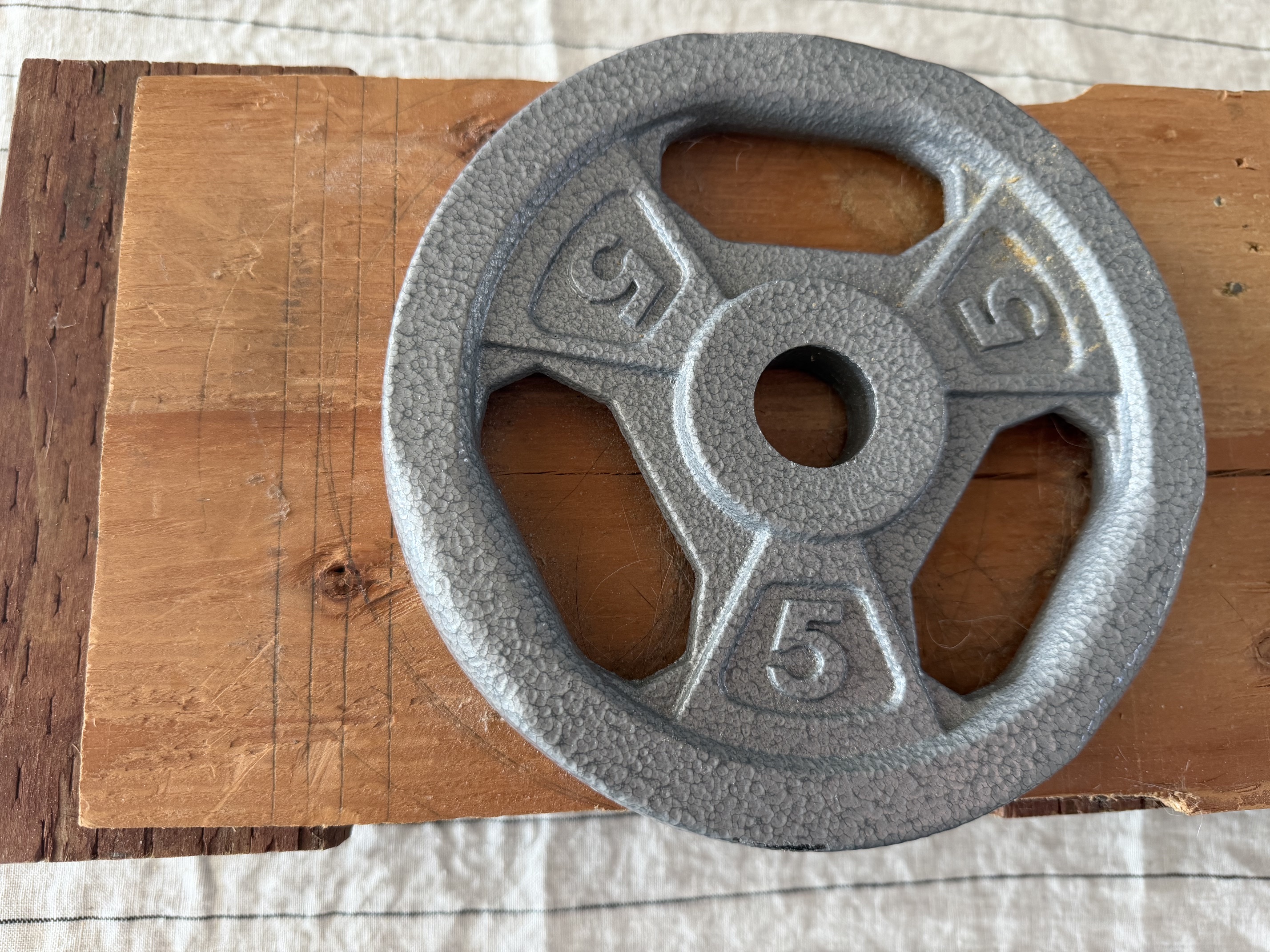
Eventually I settled on a five-pound weight plate. Five pounds, precisely placed. To operate a cardboard cat food restrictor. I hot-glued it to the rising panel. (Because of course hot glue. Gobs of hot glue.) Not wanting to bleed further, I tested it extensively with other weight plates. As best as I could tell, the smaller cats could still pass, and Blue now would trigger the mechanism reliably.
Unfortunately, when the five-pound weight moved, it moved with considerable enthusiasm. The whole assembly would jump, and the resulting impact sounded like someone dropping a piece of furniture. I added a 2.5-pound weight to stabilize the assembly and glued a strip of foam padding under the moving panel to soften the impact. It helped.
Blue, meanwhile, continued testing the apparatus - and my patience. BANG! Scrabble, scrabble, scrabble. An hour later: BANG! Scrabble, scrabble, scrabble. He was relentless. And then, somehow, he defeated it again.
The Sixteen-Dollar Solution
The latest failure took considerably longer to diagnose. The mechanism worked perfectly when I tested it on plywood in the garage. But when installed in the cardboard tunnel, the far end of the ramp contacted the tunnel floor. That contact introduced a small amount of friction. Not much. But just enough that a very intelligent cat, who had spent a considerable amount of time studying and testing the machine, could find a way to keep the gate from activating.
I considered grease. That would have been a spectacularly bad idea. Then I remembered a rather basic mechanical principle. Wheels reduce sliding friction. Off to the hardware store for casters. Eight dollars each. SIXTEEN DOLLARS FOR TWO LITTLE WHEELS. By this point, I had invested far too much time in this project to surrender over sixteen dollars.
I attached the casters to the underside of the ramp. (With hot glue, of course.) The difference was immediate. The end of the ramp now rolled freely instead of dragging across the cardboard.
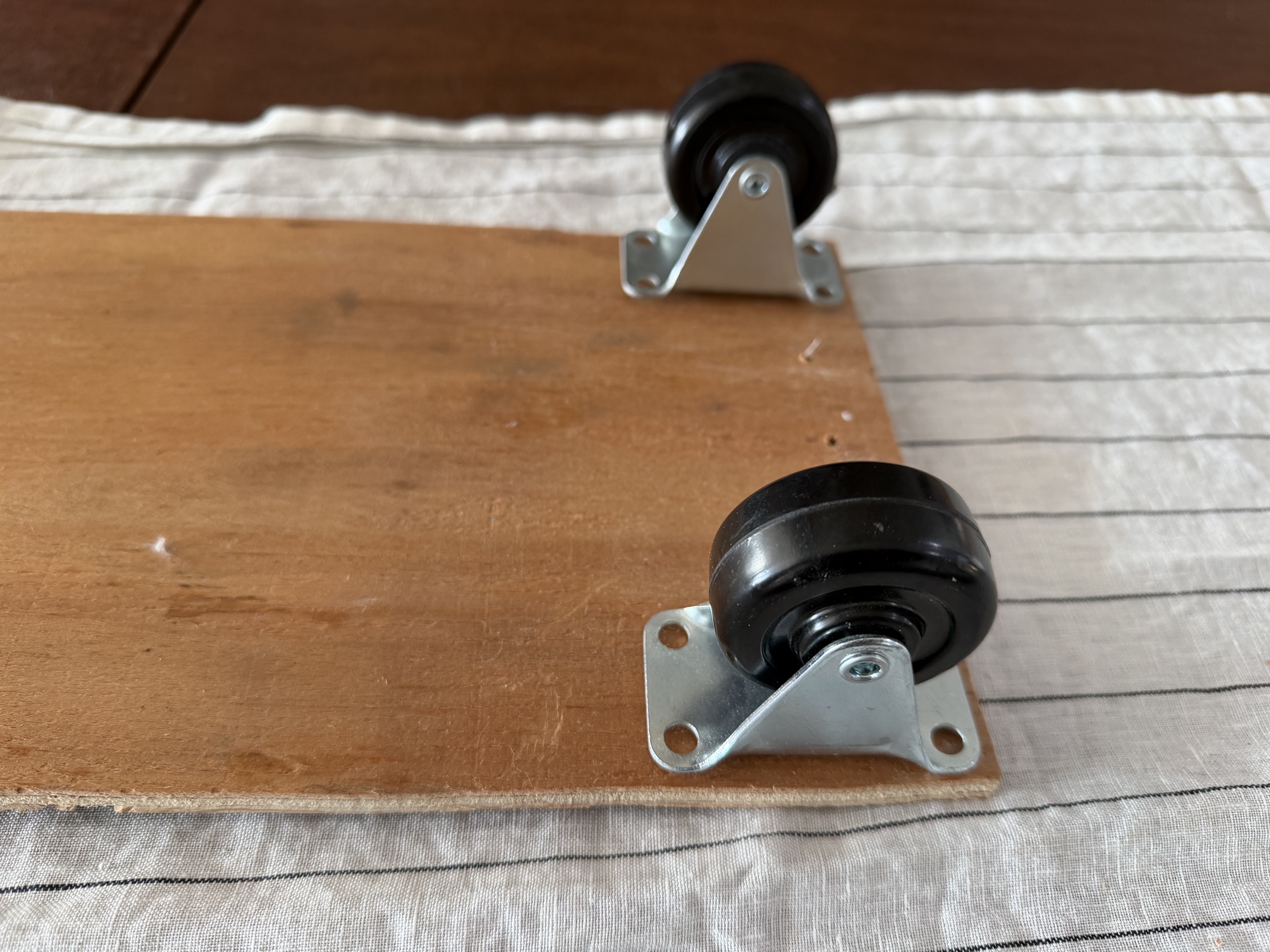
Blue tried again. The gate activated. He retreated. And, at long last, the system worked.
The Finished Product
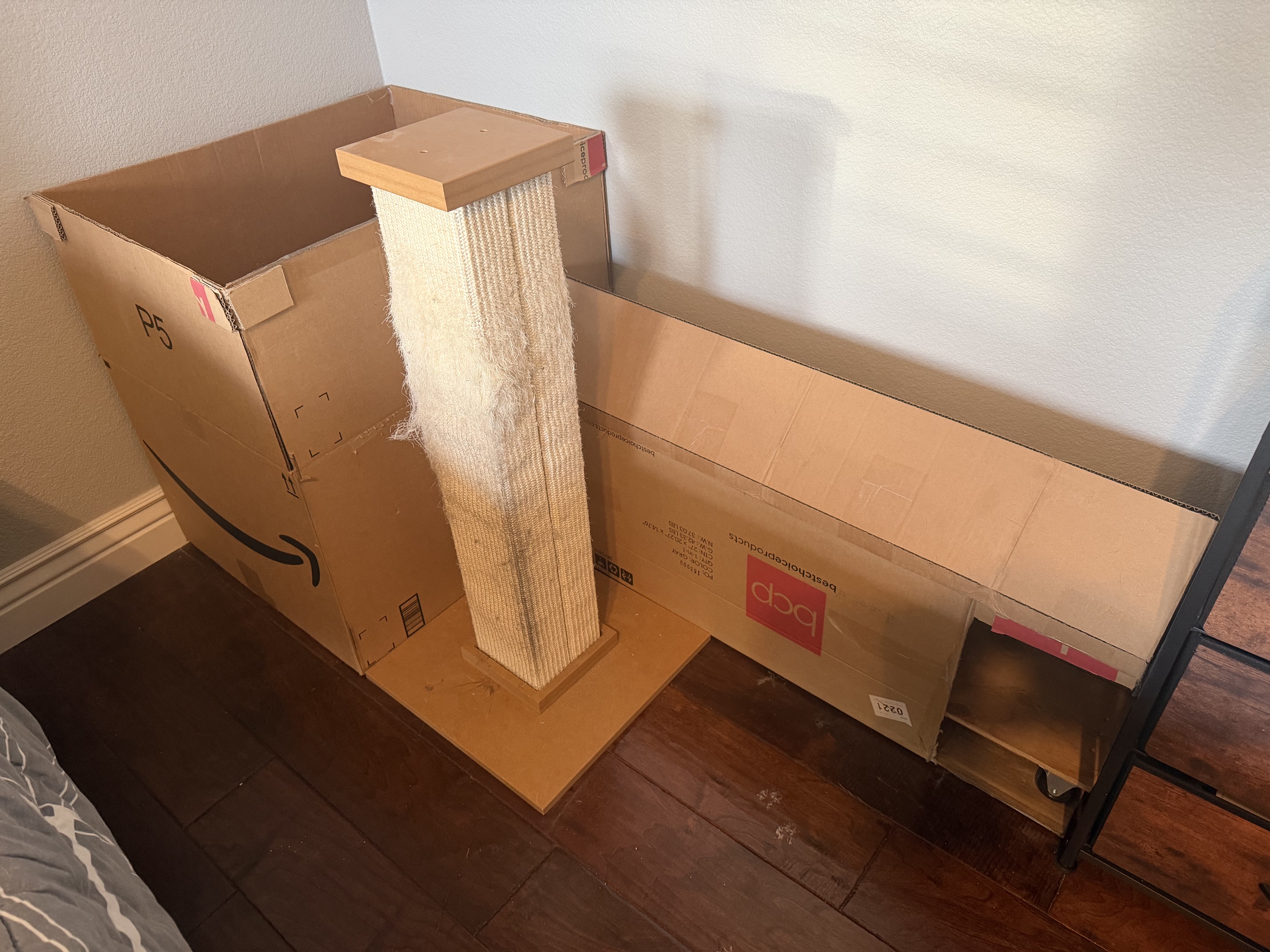
The resulting machine is one of the ugliest things I've ever built.
It's constructed primarily from scrap lumber and cardboard boxes. It includes hinges, a five-pound barbell plate, an additional 2.5-pound stabilizing weight, two casters, impact-absorbing foam, and enough hot glue to concern a structural engineer.
It has a vaulted roof, a mechanical weight-discrimination system, and, for a while, its own surveillance camera. It requires no electricity, no batteries, no sensors, no internet connection, and practically no maintenance. The smaller cats can enter the feeding enclosure whenever they want. Blue cannot.
I've spoken with veterinarians about the device, and their reactions have been rather entertaining. More than one suggested I should patent the thing. Maybe I should. But what's most interesting to me isn't the machine itself. It's how the machine evolved.
Every time I thought I'd solved the problem, Blue found another weakness. Mechanical interference. Insufficient leverage. Friction. Each failure revealed something I'd overlooked, and each required a different solution.
I didn't start with a detailed design or a set of engineering specifications. I started with a big furry problem, a rough idea, and whatever materials were lying around the house. Then I built something, tested it, watched it fail, figured out why, and made it better. Repeatedly.
Blue is still a big cat, though considerably healthier than he was at his worst. He now has his own $99 automatic feeder that dispenses six carefully measured meals a day. That commercial feeder, incidentally, depends on an internet connection. My cardboard contraption doesn't.
And to this day, Blue remains one of the most intelligent, determined, and resourceful animals I've ever known. I have considerable respect for him.
But he's not getting into that food box.